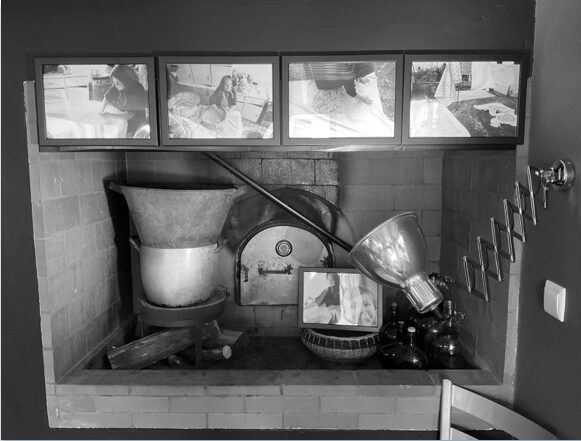
A short pasta with a long history
Today, few Madeirans know how to make couscous, known as “cuscuz” in Portuguese. This word of Berber origin, which reached us through the Arabic “kuskus”, originally designated the manual process — rolling — used to obtain this type of granulated pasta made from simple flour sprinkled with water. The same term now also refers to a typical Maghreb dish prepared with this grain, usually based on wheat and sometimes other cereals. Once steamed in a perforated vessel called a couscoussier, it can be eaten immediately or dried for later consumption.
The exact origin of couscous and how it arrived in Madeira is not known with certainty. The first references date back to the 10th century and relate to Saharan Algeria. Some authors believe it came from Sahelian-Sudanese Africa, having long been part of the food culture of the Senegambian peoples. Others claim that the Maghrebi were its inventors. The fact is that from the 12th century onwards, its consumption is often attested in north-western Morocco, spreading since then to Tunisia and Tripolitania. Subsequently, its trace is found in the Eastern Mediterranean, notably in Egypt and Syria. In the Christian world, its presence is also noted in France and Italy, but it is in the south of the Iberian Peninsula, then part of the Islamic world, that the first recipes were written down, as early as the 13th century. Couscoussiers found at archaeological sites in both Spain and Portugal confirm the testimonies of Arabic authors from this period.
It was, in fact, aboard Portuguese ships that couscous later crossed the Atlantic, becoming part of the food heritage of Cape Verde and Brazil today. While its consumption has since declined in Spain, in Portugal it is well documented throughout the modern period. It should be remembered that this country had a strong presence on the Moroccan coast during the Age of Discovery. Some authors believe that cultural contacts with the inhabitants of Barbary explain the resurgence of interest in its cuisine from the 15th century onwards. In return, the Portuguese presence in the Maghreb facilitated the arrival of Muslims through the port of Lisbon. In the 16th century, emigrants from Morocco and Tunisia, as well as those from Spain in the following century, formed the bulk of what Portuguese documents designated as “mouriscos” during this period.
Following the expulsion decreed in 1492, the former inhabitants of the medieval “mourarias” were now a minority within a minority, much smaller compared to those living in neighbouring kingdoms. For all these reasons, it is probable that the passing of the torch of Muslim food traditions, particularly that of couscous, was not the work of the descendants of the Maghrebis and Arabs who once dominated a large part of the Iberian Peninsula. The fact remains that couscous is only attested in regions that were never conquered by the Mohammedans: Trás-os-Montes, the Azores, and Madeira.
The idea that Madeirans owe couscous to Maghrebi slaves deported to the island shortly after its discovery is now firmly established. We tend to forget that this version of events is an erudite creation of Funchal intellectuals from the Belle Époque, based on an embryonic knowledge of the food history of this overseas territory. Indeed, upon closer inspection, this hypothesis does not withstand confrontation with the facts.
The “cuscuz”, as it is still prepared today in Madeira, the Azores, or Trás-os-Montes, shares certain particularities that distinguish it from that of the Maghreb and the Sahel, but also from Cape Verde and Brazil. The modus operandi varies slightly from one region to another, but all these traditions show a great number of affinities with the aristocratic and monastic recipes of this dish, described by Hispanic sources of the modern period. Starting with the raw material used, which is always wheat. While this cereal is generally the most prized, many other possibilities exist in the Maghreb. Maize is also used to roll the grain in the Sahel, Cape Verde, and Brazil. Yet, this American cereal has been a staple of the Madeiran diet for at least two centuries.
At the beginning of the 17th century, there were some arrivals of “cuscuz” at the port of Funchal from Cape Verde, probably prepared with “milho” (corn/millet). However, it is uncertain whether this word referred to maize, millet, or even sorghum. Its provenance and the other goods travelling with it suggest a connection with the slave trade—not Maghrebi, but Sahelian. Regardless, these imports quickly ceased. It is only at the end of that century that traces of couscous are found again in the first account books of the convents of Funchal. It was then a dish served in the refectory on feast days, prepared exclusively with wheat, the chosen cereal of the favoured classes.
With the exception of “cuscuz” and “cuscuzeiro”, the technical lexicon currently in use in Madeira, the Azores, and Trás-os-Montes shows no Maghrebi or Sahelian influence. The fact that Madeirans do not call their couscoussiers “bindi”, as Cape Verdeans still do today, and that no word derived from Wolof is part of this register today, suggests once again that the importation of Sahelian couscous in the early 17th century left no trace in terms of craftsmanship. It should be noted that in that region of Africa, wheat semolina is the exception that proves the rule. Furthermore, the way instruments and gestures are named corresponds to those found in Hispanic recipes of the modern period. It therefore appears that this Madeiran tradition, perpetuated today only by country folk, originates from the aristocratic milieu.